Review
Puttana
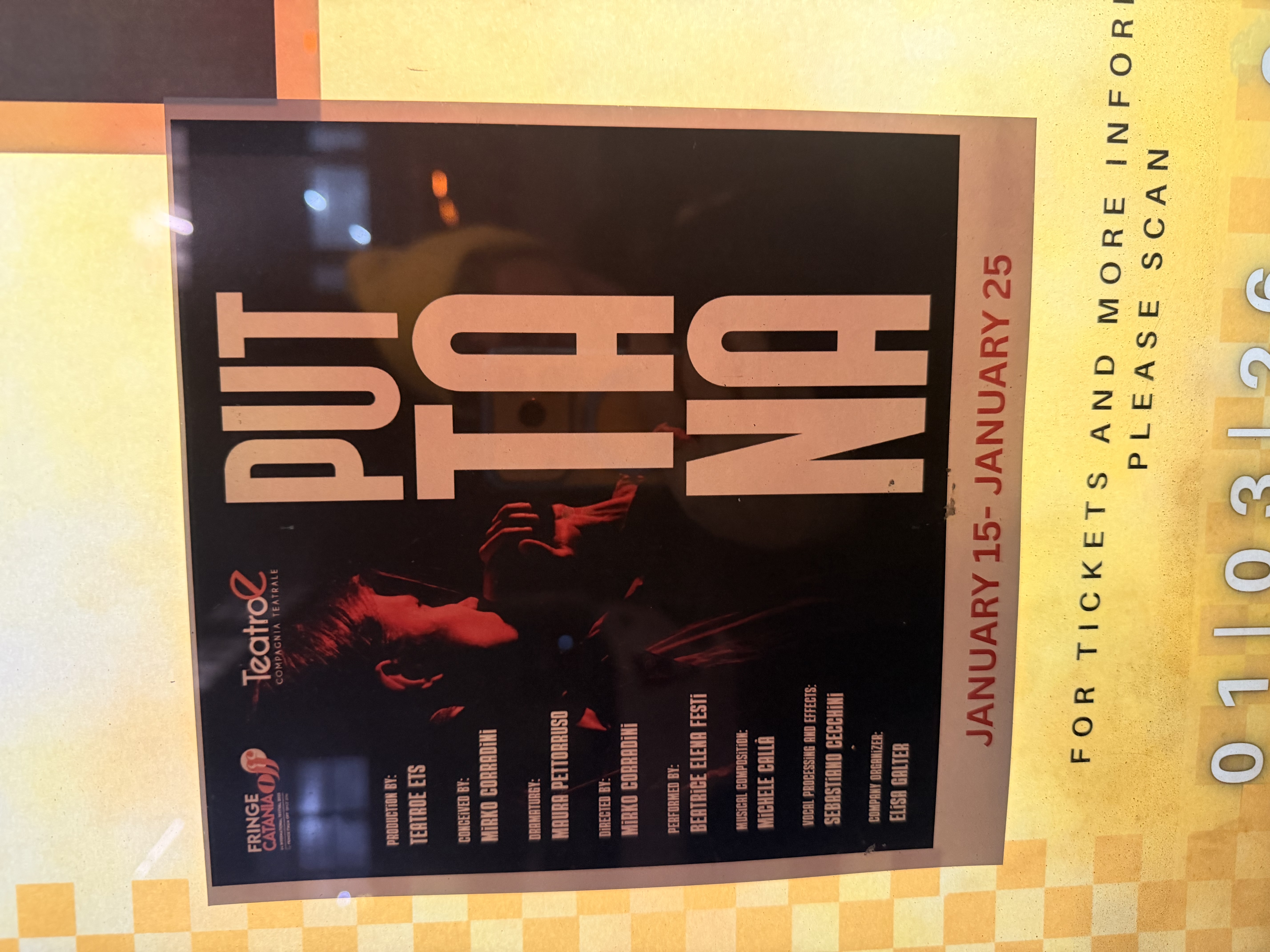
I saw the opening night performance of Puttana (whore) on January 15, 2026 at SoHo Playhouse as part of their Fringe Encore series, and it was one of the more challenging and provocative pieces I have seen in a while. This is not a comfortable show, and it is not trying to be. It asks the audience to sit inside moral ambiguity and make up their own minds.

From the moment you enter, the experience is immersive. You are handed a pair of headphones, the silent rave kind, and told the sound design will replicate being surrounded by an orchestra using 3D spatial audio. In practice, the music itself is less important than how sound is used to manipulate the performer’s voice. The effect is disorienting in a deliberate way. Voices echo, distort, multiply. It felt less like being wrapped in music and more like being trapped inside someone’s head, which worked for me.
The entire show rests on the shoulders of a single performer, Beatrice Elena Festi, and she is excellent. She shifts between five characters using only body language, lighting, and live microphone modulation. One moment she is a daughter, the next a prostitute, a wife, a mother, or a man. The transitions are clean and confident, and she never loses control of the narrative even as it fractures into fragments of lives and encounters.
The content itself is confrontational. The show is essentially a series of sexual transactions, most of them involving degradation and power imbalance. What makes it unsettling is that the encounters are presented as consensual. There is no clear villain. No obvious victim. The question the show keeps returning to is whether consent alone is enough to erase harm, and who gets to decide where morality begins and ends. As the audience, you are not given answers. You are asked to judge, or at least to notice how quickly you start doing so.

The use of technology reinforces that discomfort. Hearing Festi’s voice shift in your ears while watching her body change in front of you creates a sense of distance and intimacy at the same time. It blurs the line between performer and character, between observer and participant. At times it felt almost invasive, which I suspect is entirely the point.
This production was discovered at Fringe Italy, and it makes sense. It feels firmly rooted in experimental European theater traditions: avant garde, fragmented, unapologetic. It will not be for everyone. Some people will find it repetitive or emotionally exhausting. Others will find it gripping.
I left the theater unsettled, thinking about the questions it raised rather than the plot itself. Puttana (whore) is less about telling a story and more about forcing a confrontation with ideas around bodies, labor, desire, and judgment. It is ambitious, uncomfortable, and often effective. I am glad I saw it, even if it never once tried to make me feel good.