Review
Mindplay
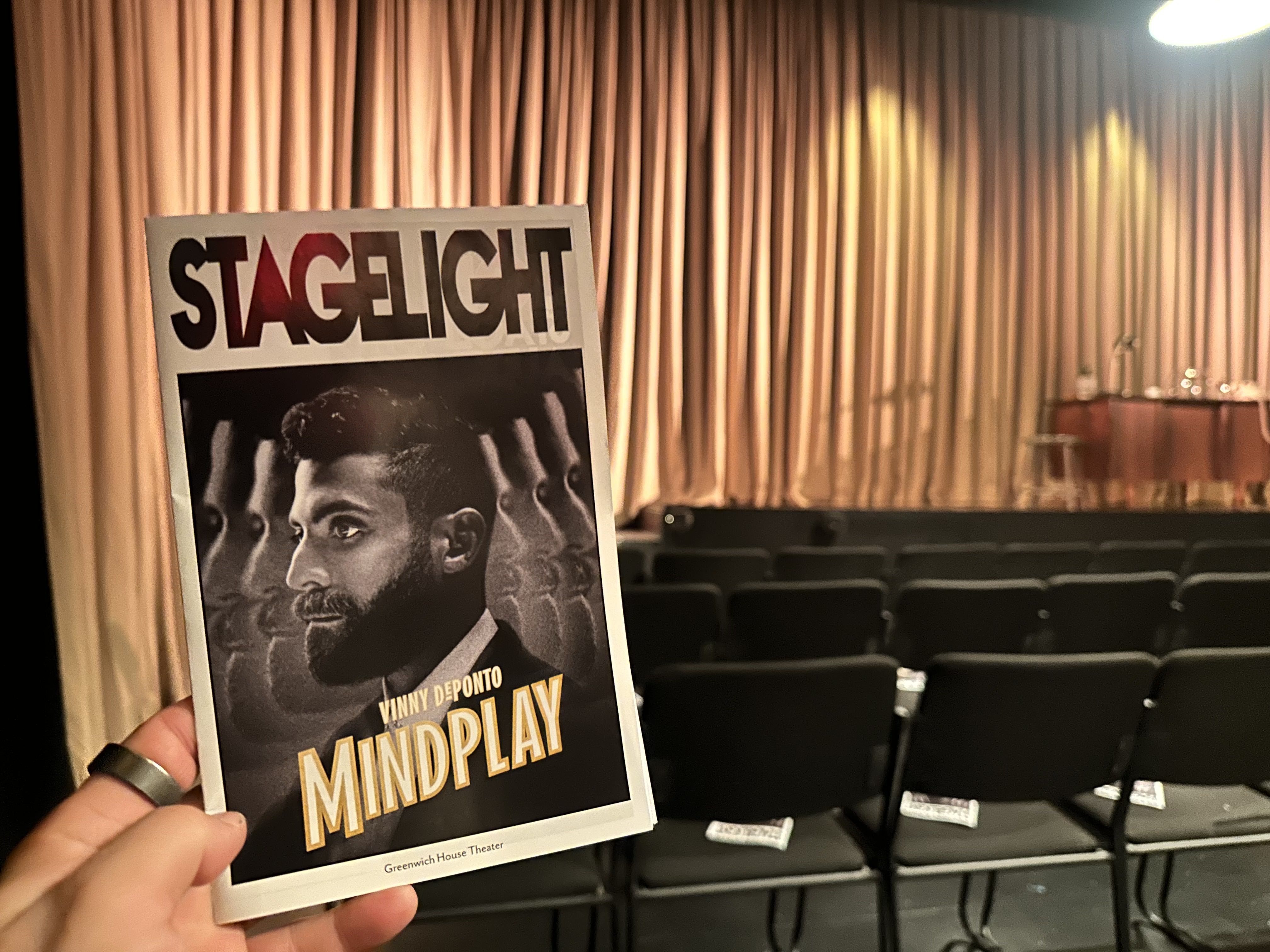
Vinny DePonto wants to know your deep, dark secrets—he says so himself. As a mentalist, exploring minds is his specialty, and any audience member attending Mindplay at Greenwich House Theater runs the risk of DePonto seeing straight into their soul. But this isn’t some ominous, shadowy ritual; instead, it is a mesmerizing, often humorous, deeply engaging theatrical experience that blends magic, psychology, and storytelling into a uniquely immersive evening.
Co-created by DePonto and Josh Koenigsberg and directed by Andrew Neisler, Mindplay is not merely a demonstration of mentalism but an exploration of the human mind itself—its memories, anxieties, and uncanny ability to be both deceived and delighted. Over the course of 85 minutes, DePonto invites us into his own "memory palace," a conceptual space where he stores and organizes recollections, as he guides us through his personal history and, in doing so, unlocks pieces of ours.
As a seasoned magician and mentalist, DePonto’s skills are indisputable, but Mindplay is not just about tricks. It is a theatrical meditation on memory, nostalgia, and the fragility of human recollection. Through a combination of storytelling, audience participation, and striking visual elements—including shadowplay and projected images that enhance the emotional resonance of his illusions—DePonto crafts an experience that feels simultaneously intimate and grand.

An Invitation to Vulnerability
From the moment the audience enters the theater, they become part of the show. Each attendee is asked to write down something that has been weighing on their mind—a fear, a memory, a dream—and place it in a bowl on stage. These anonymous confessions form the backbone of the evening’s illusions, as DePonto seamlessly weaves them into his narrative. At various points, he retrieves slips from the bowl and astonishes the crowd by revealing intimate details about their contents, often connecting them to the broader themes of the show.
Despite his ability to seemingly read minds, DePonto never feels invasive. His stage presence is warm, disarming, and intimately human. He balances his acts of revelation with moments of self-reflection, sharing memories of his childhood, his fascination with mentalism, and the emotional weight of recalling moments long past. His humor, self-deprecation, and gentle manner make even the most apprehensive participants feel at ease, encouraging them to embrace the experience rather than fear it.
The Art of Deception and Memory
One of the show’s central themes is the fallibility of memory. DePonto explores how our recollections are often unreliable, shaped by emotions, biases, and time. He demonstrates this through a series of illusions that challenge the audience’s perception, making them question what they just saw or heard. A whispered word passed through a chain of people morphs into something unrecognizable by the time it reaches its final recipient. A shared memory turns out to be a fabrication. A simple deck of cards becomes a tool for uncovering long-buried emotions.
Throughout the performance, DePonto references real-world examples of memory manipulation, such as the work of Solomon Shereshevsky, a mnemonist with an extraordinary ability to recall details but an inability to forget. He draws parallels between Shereshevsky’s mind and our own, prompting the audience to consider how much of what we remember is true and how much is reconstructed from fragments of our experiences.
The Role of Audience Participation
Mindplay is not a passive experience. DePonto directly involves the audience, selecting individuals to join him on stage for various demonstrations. In my performance, participants moved through a spectrum of emotions—initial nervous laughter giving way to astonishment, reverence, and even moments of genuine introspection. Whether revealing a hidden thought, predicting a participant’s actions, or uncovering connections between complete strangers, DePonto crafts an experience that feels both personal and communal.
Yet, the show never feels exploitative. Unlike some mentalism acts that rely on shock value or manipulation, Mindplayis built on a foundation of trust and mutual curiosity. Even when DePonto seems to pluck a thought directly from someone’s mind, his reactions are never gloating or smug; they are gentle, understanding, and always laced with wonder.
A Theatrical Experience, Not Just a Magic Show
While Mindplay is, at its core, a mentalism performance, it also exists as a piece of theater. The production design, led by scenic designer Sibyl Wickersheimer, transforms the Greenwich House Theater into a dreamlike space that shifts in mood and texture. Lighting and projections play a significant role in enhancing the show’s themes, creating a visual poetry that underscores DePonto’s narrative. Moments of darkness and shadow contribute to the illusion of the mind as an enigmatic, ever-shifting landscape, while brighter, more open sequences provide warmth and familiarity.
This is where Mindplay diverges from a traditional magic show. It is not merely a series of tricks but a structured, theatrical experience with a clear emotional arc. It invites audiences to reflect on their own memories, fears, and desires, elevating it beyond mere spectacle into something more profound.
A Personal Perspective
As someone with a foundational understanding of mentalism from my college years, I came into Mindplay with a degree of skepticism. While I expected to be entertained, I also assumed I might be able to see through at least some of the techniques. And yet, I was fooled more than once. DePonto’s skill is undeniable, but what surprised me most was how emotionally invested I became.
There were moments where the show felt less like a performance and more like a conversation—not just between DePonto and the audience, but among all of us in the room. We became part of something ephemeral, a collective exploration of thought and memory. And when the show ended, I left not only impressed but also contemplative, my mind buzzing with questions about what I had witnessed and what it said about the nature of perception itself.
Final Thoughts
Mindplay is a masterful blend of magic, psychology, and storytelling that transcends the boundaries of traditional mentalism. Vinny DePonto is not just a magician; he is a storyteller, a philosopher, and a guide into the hidden recesses of the mind. The show is both dazzling and deeply introspective, leaving audiences not just entertained but enriched.
For those seeking an evening of jaw-dropping illusions, Mindplay delivers. But for those open to something more—a journey into memory, identity, and the fragile beauty of human perception—it offers an experience that lingers long after the final curtain.
Highly recommended for anyone who enjoys theater, magic, or simply the thrill of being surprised by the limits of their own mind.