Review
Mars
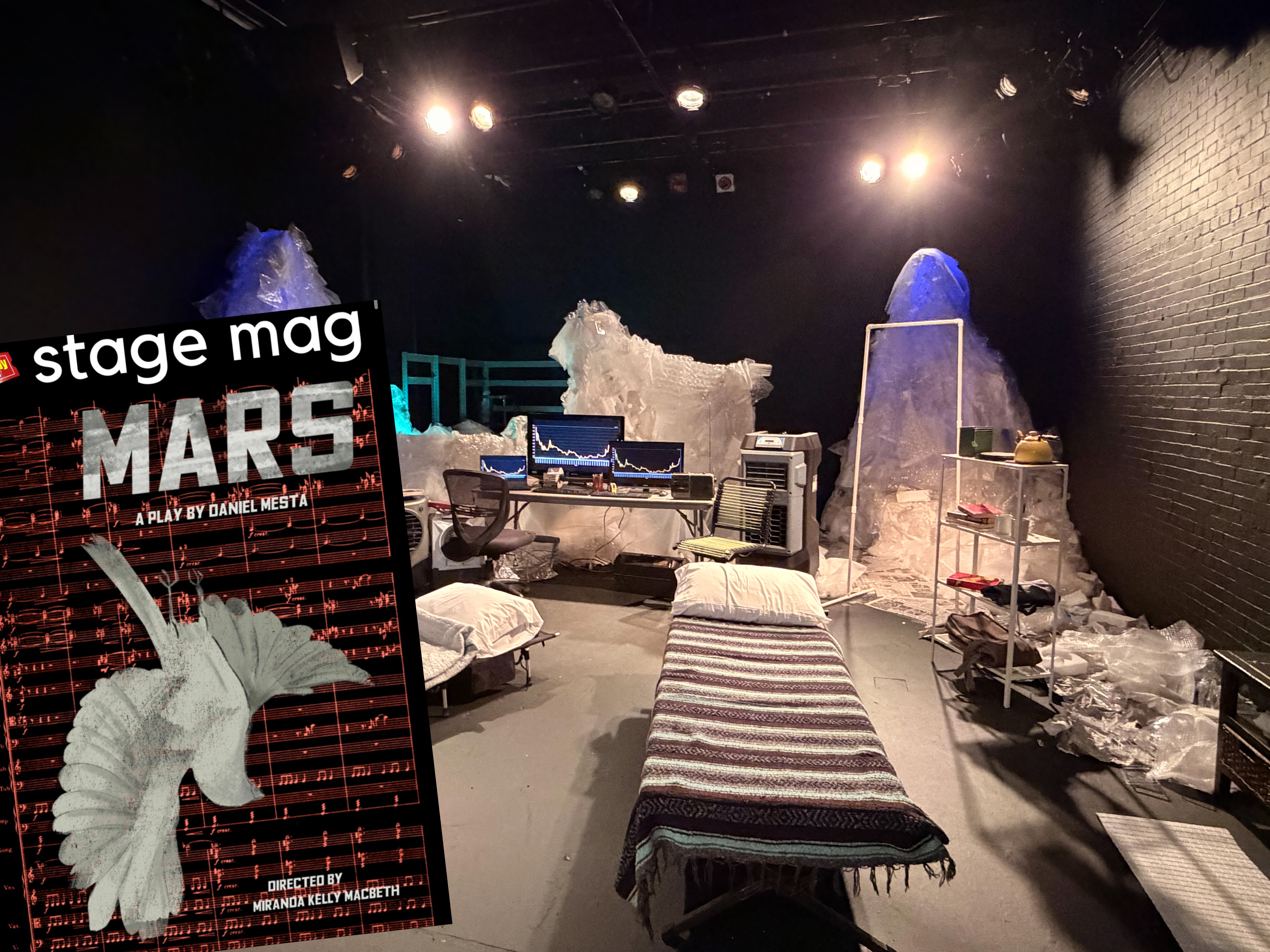
I saw Mars at The Chain Theatre and found it thoughtful, somber, and quietly unsettling. The premise is simple and heavy. Two men may be the last humans alive, stranded in an Arctic research station after some undefined global collapse. From the start, the play leans into isolation and finality, asking what remains of humanity when progress has failed and there is no one left to impress or convince.
The performances carry the piece. Dima Koan plays Kovalenko, a Russian American glaciologist who feels anchored to history, language, and culture. Fernando Zermeño Garavito plays Valdez, a Mexican American climatologist whose past mission to Mars looms over everything. Both actors handle the material with seriousness and restraint. There is no melodrama here. Their work feels grounded and human, which is essential given how abstract the circumstances are.

Valdez’s experience on Mars becomes the emotional spine of the play. His mission failed, and the play strongly suggests that this failure may have sealed humanity’s fate. That weight sits heavily on him. His regret is not loud or theatrical. It is quiet and corrosive. The idea that one man’s mistake could ripple outward and end everything is devastating, and the play allows that guilt to linger without resolving it.
Daniel Mesta’s writing explores big ideas about legacy, responsibility, and meaning at the end of the world. Conversations drift between science, memory, politics, and poetry. There is talk of Pushkin and progress, of what humanity tried to build and where it went wrong. The tone feels deliberately spare, almost austere, which fits the frozen setting and the emotional distance between the characters.
That said, the play’s biggest weakness for me is its refusal to give clearer answers. We never fully understand what caused the apocalypse or why help never came. Some information appears briefly on computer screens, but it is minimal and fleeting. I wanted more direct conversation between the two men about what actually happened and what they believe is still happening outside the station. Ambiguity can be powerful, but here it sometimes felt like withholding rather than tension. I tend to want facts, especially when the stakes are this large.
Still, Mars succeeds as a mood piece and a character study. Miranda Kelly Macbeth’s direction keeps the focus tight, and the design elements support the atmosphere without overwhelming it. Xenia Clement’s sound design, drawing on Holst’s The Planets, one of my favorites since childhood, adds a cosmic sense of scale that contrasts sharply with the smallness of the human story onstage. Wendy Triana’s costumes reinforce the practicality and bleakness of survival. While I left wishing for more clarity, I also left thinking about the questions the play raises. What do we owe each other. What do we leave behind. And what would we say if we knew we were truly the last ones left.