Review
DATA
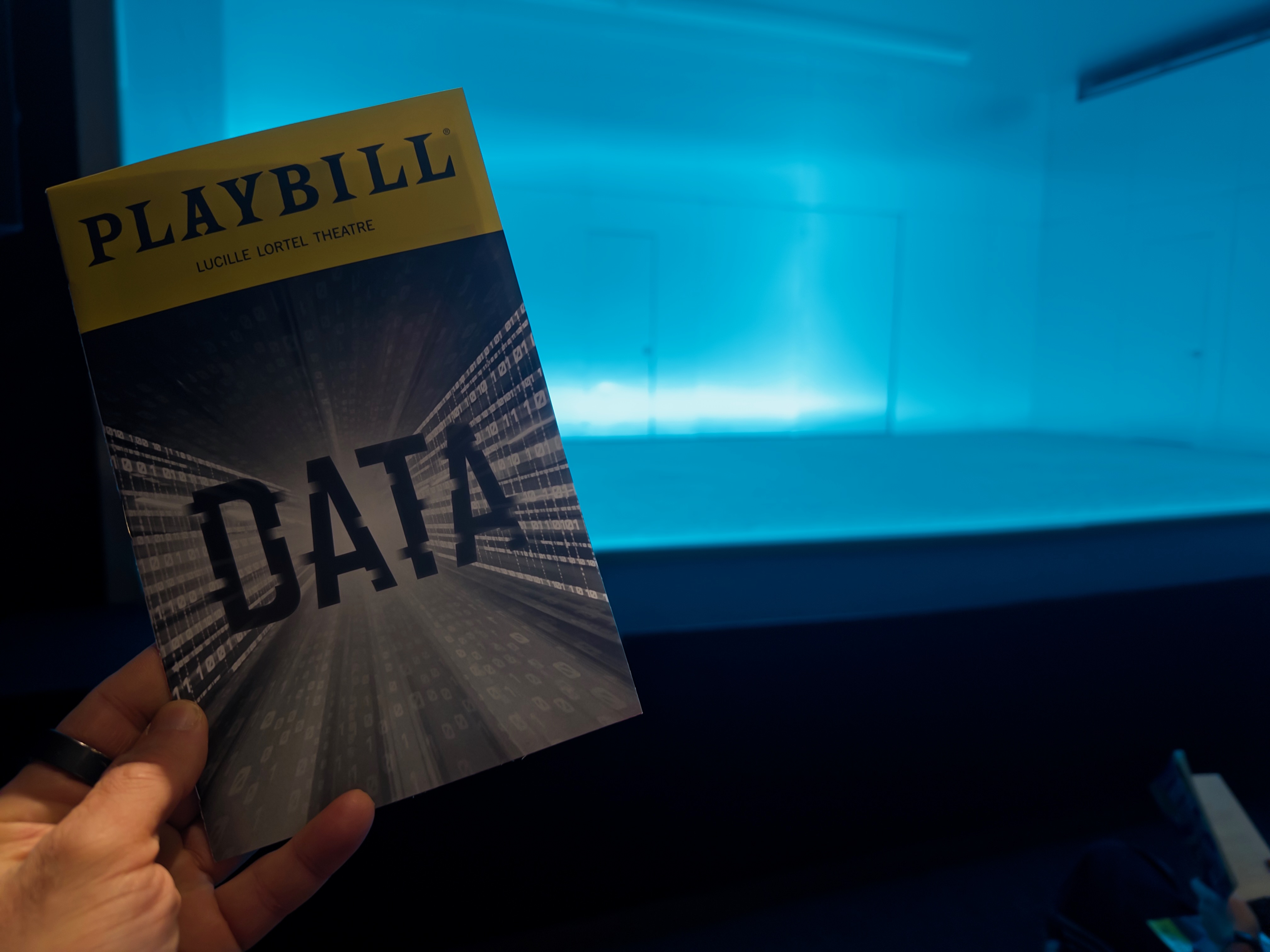
I saw DATA at the Lucille Lortel Theatre on February 4, 2026 for the matinee, and I was pulled in almost immediately. This is smart, unsettling theater that trusts its audience to keep up and asks questions that feel uncomfortably close to our daily lives. It never feels like science fiction. It feels like tomorrow morning.

At the center of the play is Maneesh, a young programmer who takes a job in the tech world believing he is stepping into the future he has worked toward. What he slowly comes to understand is that the academic work he once created in isolation might be used for more than just predicting baseball statistics. The conflict is not about invention, but ownership and intent. Maneesh is forced to confront how his ideas will be used once they are no longer his, and what responsibility he bears when his work becomes part of a system that operates far beyond individual control.
Karan Brar is excellent as Maneesh, capturing that internal fracture between ambition and dread. His performance is deeply human. You can see the calculation happening in real time as he weighs safety, success, familial obligation, and conscience against one another. He never plays the character as naive or heroic. Instead, Brar makes Maneesh feel like someone many people would recognize, talented, hopeful, and suddenly aware that the cost of participation may be higher than expected.

The supporting cast is equally strong. Brandon Flynn is sharply effective as Jonah, embodying the confident tech bro worldview that normalizes moral compromise through language of efficiency and progress. Justin H. Min brings depth to Alex, a data analytics supervisor whose own choices suggest that survival within these systems often requires selective blindness. Making her New York theater debut, Sophia Lillis is terrific as Riley, a young analyst trying to reconcile her work with her conscience. She brings urgency and emotional clarity to the play, grounding the ethical questions in lived anxiety rather than abstraction.
Matthew Libby’s script is clear eyed and unnervingly plausible. It explores hidden data mining, public data scraping, and AI driven judgments that occur without transparency or human accountability. The play never feels speculative for speculation’s sake. One line drew laughter from the audience when a particular form of surveillance was framed as hypothetical. The laugh landed awkwardly because many people now know that this practice has since been publicly confirmed. That moment alone says a great deal about how fast reality is moving.

The staging is deceptively simple and highly effective. The large, mostly empty stage creates a sense of exposure, as if the characters are always being watched. Scene changes happen silently in darkness, punctuated by pulsating animated light around the proscenium that flows seamlessly from moment to moment. The transitions feel mechanical and impersonal, reinforcing the sense that the system is always running, regardless of who is inside it.
What DATA ultimately asks is not whether these systems exist, but how easily people are absorbed into them. It raises questions about consent, complicity, and the illusion of choice in environments designed to reward compliance. There are no easy villains here, only people navigating structures that benefit from moral distance.
Oh, and Brar and Flynn's ping pong skills are impressive.
I thoroughly enjoyed this production. It is tense, thoughtful, and disturbingly grounded in the present moment. The performances are strong across the board, and the play trusts its audience to sit with discomfort rather than offering reassurance. DATA is currently scheduled to run through March 29, 2026, and I highly recommend seeing it while you can. If they had magnets, I would have bought one.
I rarely do stage doors, but with the small ensemble, and very short line outside when I left the theatre, I decided to stick around for a few minutes and was able to meet and briefly chat with the entire cast.


