Review
Anna Christie
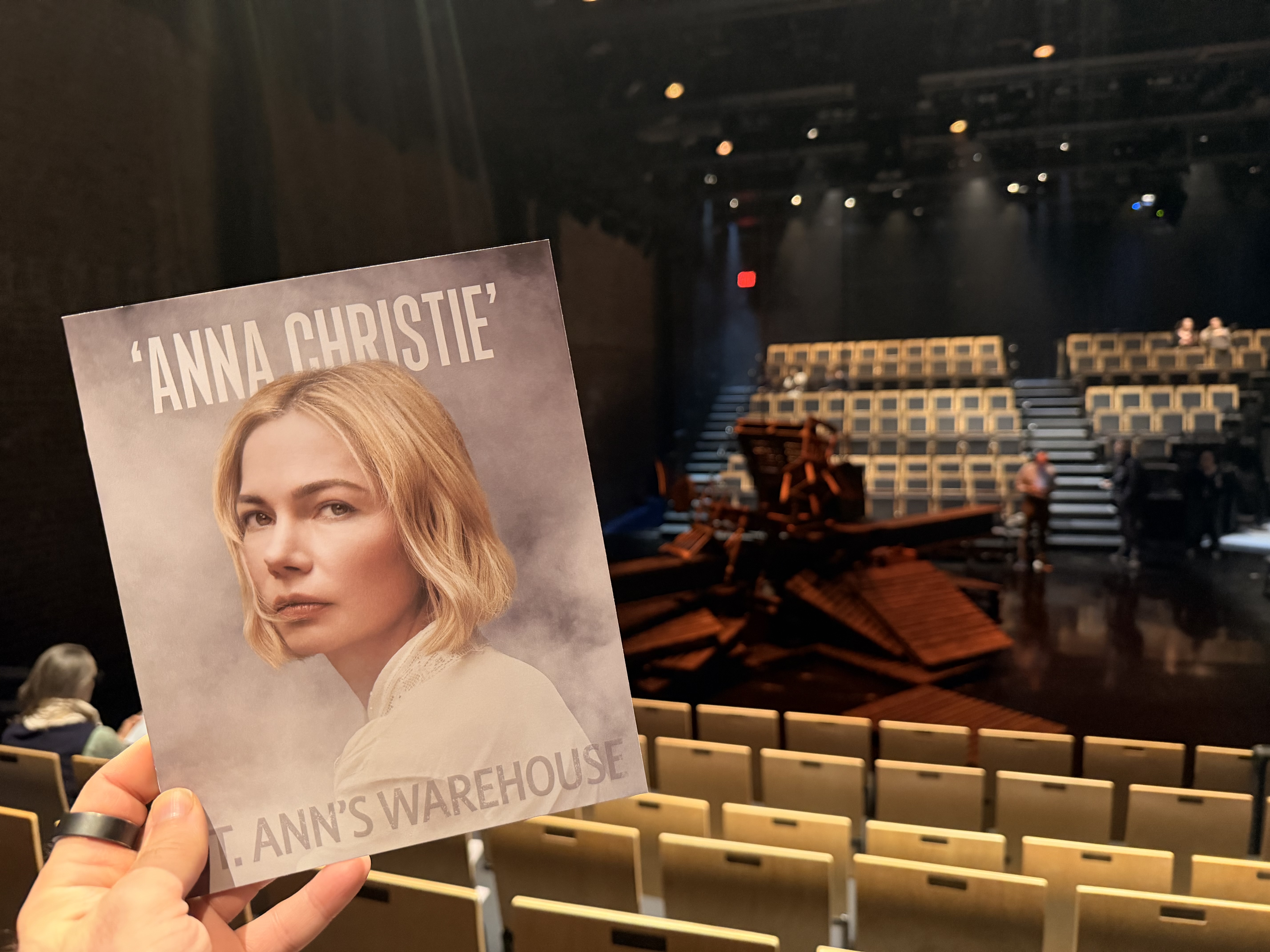
I saw Anna Christie at St. Ann’s Warehouse on January 13, 2026 at the 7:30pm performance, and it was deeply moving. Starring Michelle Williams, Tom Sturridge, and Brian D’Arcy James, this production delivered a raw and emotionally honest take on one of Eugene O’Neill’s most important plays. I came primarily to see Brian D’Arcy James, and I left grateful I did.
Originally premiering in 1921 and earning O’Neill the Pulitzer Prize, Anna Christie was groundbreaking for its time. It centered a woman with a sexual past and treated her with empathy rather than punishment. O’Neill was deeply interested in realism, moral complexity, and the ways people are shaped by regret, guilt, and circumstance. Those ideas remain central here.
The story follows Anna Christopherson, a young woman reconnecting with her estranged father Chris, a coal barge captain who abandoned her years earlier. When Anna falls in love with Mat Burke, a sailor rescued from a shipwreck, the fragile family unit begins to crack. A bet and a test of class are not the engine here. Shame, secrecy, and the fear of being truly seen are.
One of the central questions of the play is whether Anna can escape her past. Another is whether the men in her life can see her as a full human being rather than an idea. O’Neill never offers easy answers. The play lives in moral ambiguity, asking whether redemption comes from forgiveness, truth, or simply survival.
The staging supported those ideas beautifully. The set was spare and functional, made of wooden pallets, a few tables and chairs, and a looming I-beam that moved effortlessly between scenes. It felt abstract and psychological rather than realistic, keeping the focus on the emotional weight of the story rather than period detail. The space constantly shifted, mirroring how unstable these relationships are.

Michelle Williams was extraordinary as Anna. Her performance during the moment when Anna reveals her past to her father and Mat was devastating. Williams acted her butt off. The confession landed with raw force, filled with anger, shame, and defiance all at once. She made Anna’s demand for dignity feel urgent and earned.
Brian D’Arcy James was the emotional anchor of the production. His Chris Christopherson was a man crushed by regret, trying to bury his failures in superstition and drink. Watching him grapple with the realization that his absence helped destroy his daughter’s life was heartbreaking. James brought depth and humanity to a character who could easily slip into caricature.
Tom Sturridge gave Mat Burke a volatile edge that worked well. His Mat felt dangerous, passionate, and emotionally immature. When Anna’s secret comes out, his reaction is ugly and explosive, but Sturridge also let us see the fear and confusion underneath. It made Mat’s eventual reckoning feel painful rather than convenient.
At its core, this production argued that class divisions are artificial, but emotional damage is not. Language, gender, and power shape how people are treated, but the real struggle is whether love can survive honesty. Anna changes, but not into what the men expect. She gains self-respect and demands agency over her life.

This was not a modernization of the text, but a modern presentation of timeless truths. It reminded me why O’Neill still matters and why this play continues to resonate.